
How to Build a Sales Engine With Claude Code
Let your agents handle admin so you can focus on closing

70% of a sales rep’s week is spent on research, follow-ups, and logging things — none of which generate revenue.
When I wanted to set up a sales engine for my AI agency, the first thing I looked to automate was that 70%.
So I designed a sales system with Claude Code.
Why build it myself?
Because it gave me much better control over my workflows, allowed me to select the right tools for each job, and meant I would be minimizing the amount of time spent clicking through clunky UIs (user interfaces).
I’ve used Clay.com in the past, and even though it’s an amazing product it is also lacking in key aspects — both too UI-heavy and too expensive.
Clay’s credit system mixes automation and data costs, and with an expensive Claude Max 20x plan I should have all the automation I need in house.
So for company data I settled on Apollo.io instead.
Prescreening companies
Below is a simplified view of the prospecting flow I built with Claude Code:
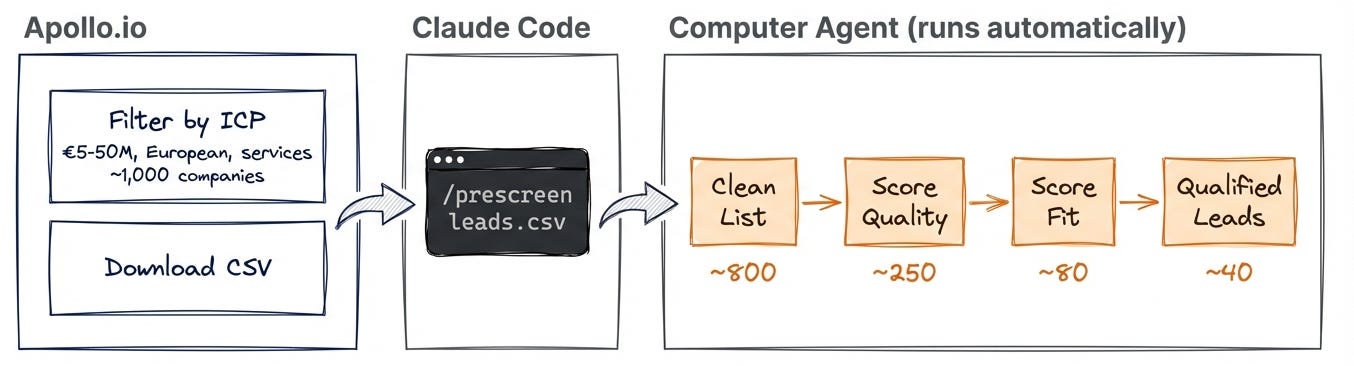
The only manual steps in this flow are in the Apollo.io UI. I use the Apollo UI to filter their company database on companies that match my AI agency ICP (Ideal Customer Profile — European services-heavy companies with EUR 5-50M ARR).
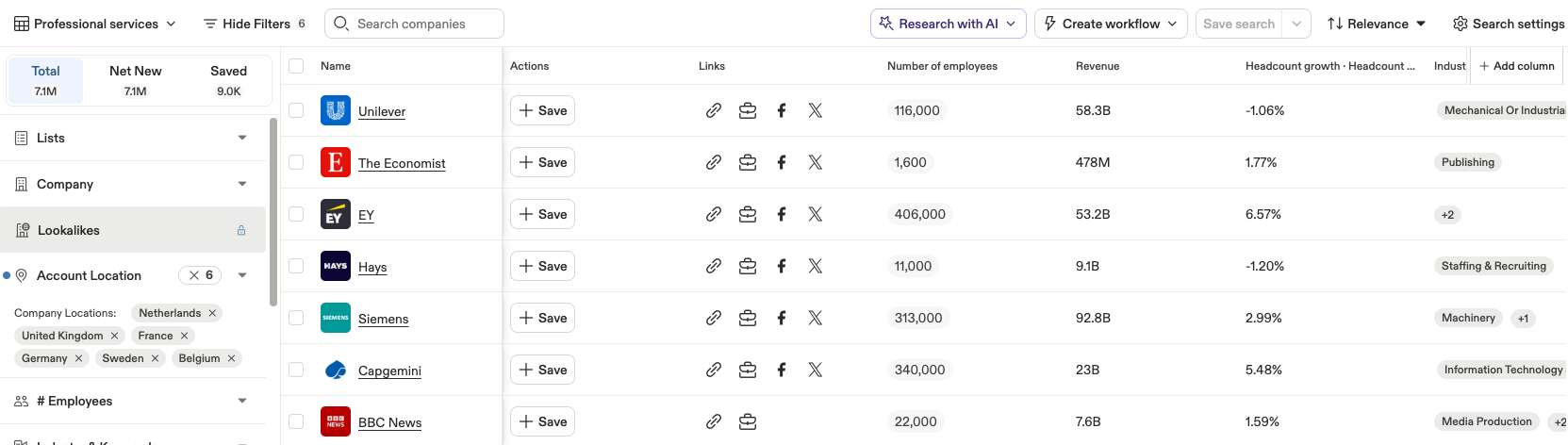
Once I have that list, I download it and ask Claude to run the /prescreen skill.
This will trigger Claude to filter the company list downloaded from Apollo on the most promising candidates for outreach based on contextual criteria, using research from Web Search and Perplexity to augment the Apollo company data where needed.
In the example above, prescreening prospects filtered out 90% of the companies in the list I downloaded from Apollo based on poor fit with my services offering, poor financial performance, or lack of signal that they had their shit in order.
Given that prescreening can take 10-20m per company, I just saved myself at least 20 hours by letting Claude do the prescreening for me. Total costs? Roughly EUR 35 in Perplexity API credits + my monthly Claude license fee.
And because of the outreach volumes I hit as a solopreneur, I only needed to get a paid subscription to Apollo for one month (~EUR 60), which I used to download multiple lists with different customer profiles.
In total, building this list of prospects to reach out to cost roughly EUR 100.
Cold outreach
Once I knew who to reach out to, I needed to create an outreach schedule of the most high-potential prospects on the list. With the initial lists of thousands of companies already reduced to a more manageable couple of hundreds, I can ask Claude to rank the prescreened companies based on the data it found during prescreening.
Per week I’m reaching out to around 20 new prospects, which usually means I need to sift through around 40 companies from the prescreened list — it has a hit rate of ~50%.
Once I have the list of 20 prospects I want to reach out to in a week, I run a custom skill in Claude Code called /lead-source that runs the following workflow for each of the companies I want to target:
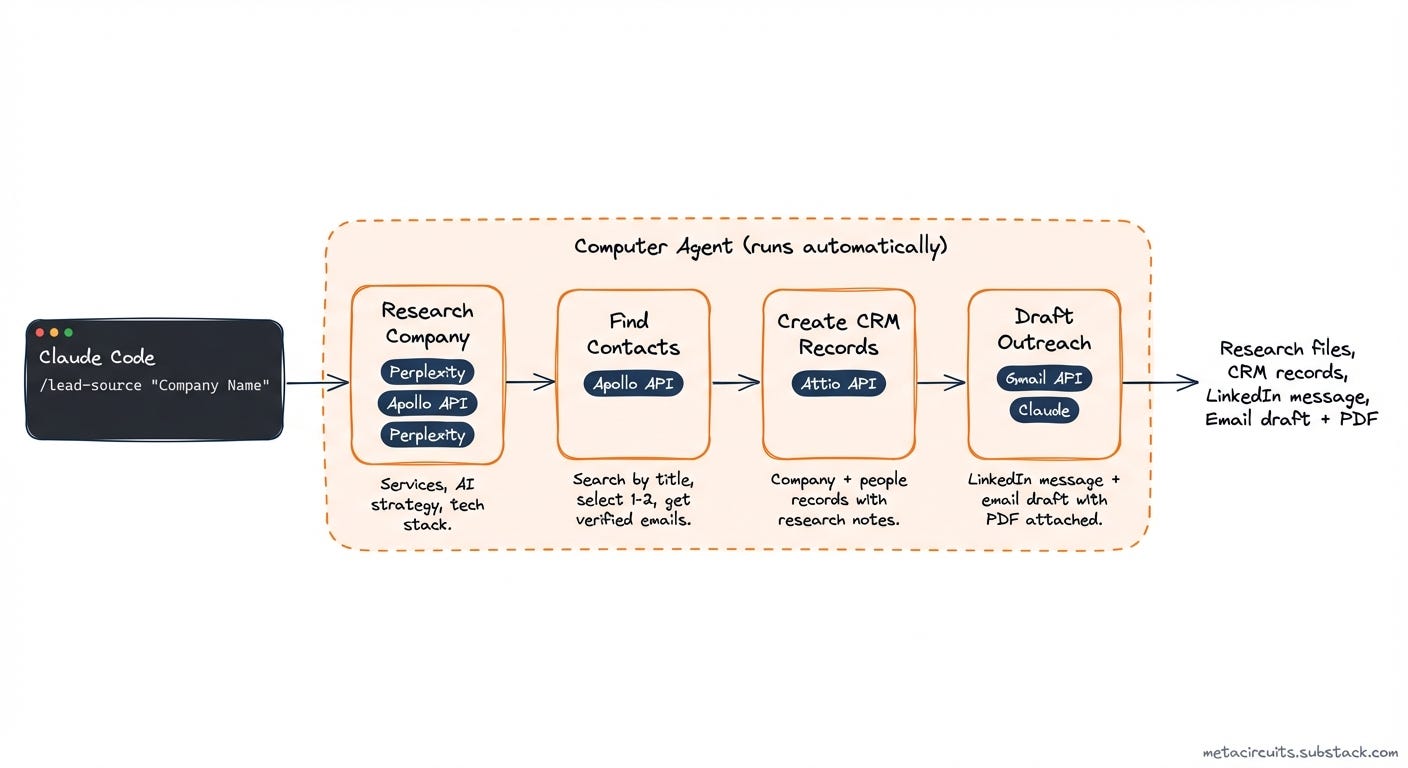
Because Claude can run this skill in parallel for multiple agents, it will finish in no time for the entire list of companies on the outreach schedule.
This gives me:
Email addresses and LinkedIn profile URLs for the most likely people to contact for my services — for the key decision-makers at those companies most relevant to me. Claude sources the contact data from Apollo using API calls.
A CRM record in my CRM — Attio — created by Claude using the official Attio CRM. This allows me to track who I’ve reached out to, who doesn’t want to be contacted again, and my deal pipeline.
An AI-generated report in PDF format for each company. The reports identify potential operational and strategic bottlenecks for the company, and walk through how my services could help. The reports are based on Apollo company data and the desk research done by Claude on the company using Perplexity.
A first draft of the LinkedIn message and cold outreach email. Email drafts are directly created in Gmail with the PDF report as attachment using a custom Gmail MCP server I asked Claude to generate.
And because I connected my cold outreach email account to Attio, it will pick up on any emails I send and automatically update the interaction details for that company.
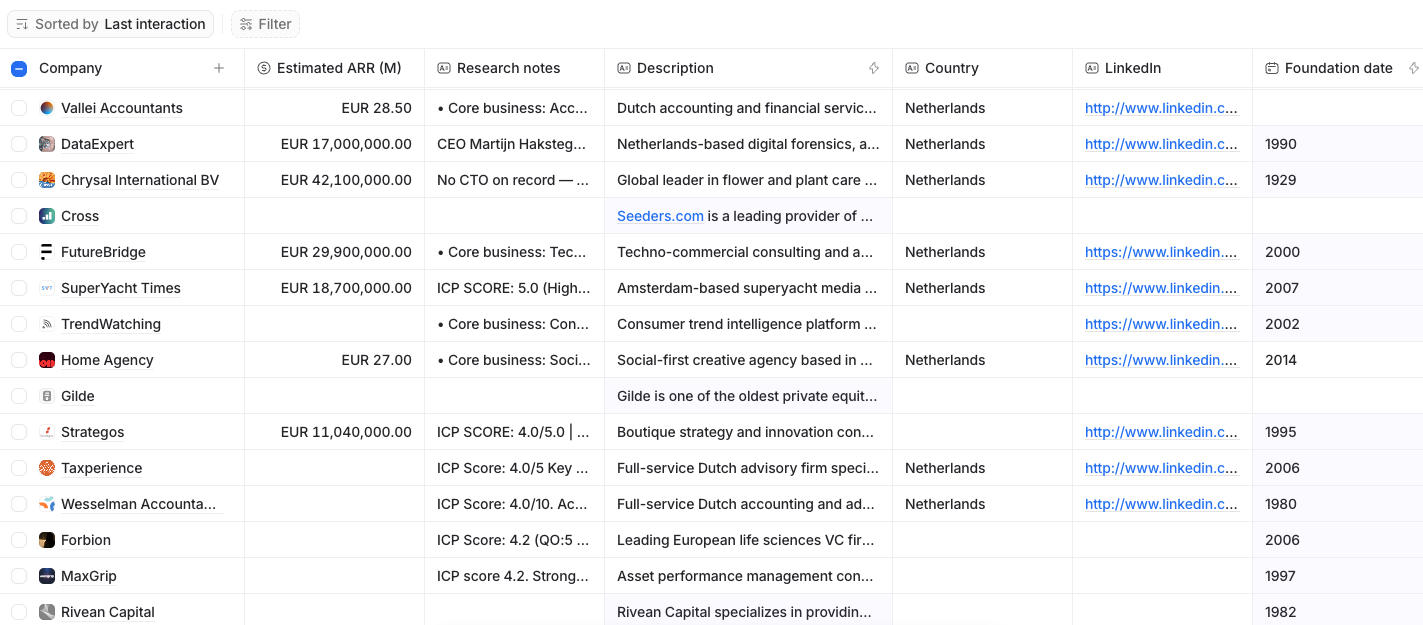
The only thing left for me to do is check and edit the AI-generated email draft and report, and hit send when I’m happy with the result. This will take me a couple of minutes per prospect — saving me a lot of time I don’t have as a solo operator!
Note: I am using a dedicated Gmail account for sales. Even though at my volumes (~100 emails per month) the risk of my email domain getting flagged as spam is very low, it is not zero. And once your domain has been flagged, deliverability will suffer and it will be hard to recover. In addition, by using a dedicated email account I feel much more comfortable both giving Claude access to it via MCP and connecting it to Attio.
Why this matters beyond my agency
The system I just walked you through is custom to my workflow. That’s the point.
Every sales rep I’ve worked with has their own way of doing things — their own research habits, their own CRM shortcuts, their own outreach cadence. Traditional sales platforms force everyone into the same UI and the same workflows. Computer agents flip that: reps define what they need, and the agent handles execution.
And because the agent handles execution, everything gets logged automatically. No more begging reps to update the CRM after every call — the research, the outreach, the contact data all flow into the system as a byproduct of the work itself. Given that 79% of sales interactions never make it into a CRM, that alone is worth the setup.
One thing I would not do is let agents send outreach unsupervised. Keeping a human in the loop isn’t just quality control — it’s how reps stay sharp on what their agents are doing and steer them toward better results.
The winning formula is humans + agents, not agents replacing humans.
AI-first is API first
A closing thought.
In selecting a CRM for my sales engine, I landed on Attio because of two simple reasons: 1) it has a generous free plan, and 2) it has an official MCP server.
When you are thinking of making your life easier by leveraging computer agents to do your rote administrative tasks for you, selecting the right software and tools around the agents is more important than you might think.
As an engineer, my preference for API-first software has more than once helped me stumble into software with the right levels of abstraction to support computer agents.
Only software providers that have strong layers of abstraction required to maintain functional APIs will be able to set up the right MCP servers. So keep that in mind when you’re selecting software for your AI-native stack.
Want a system like this for your sales pipeline? Reply to this email or DM me on Substack.
Last week in AI
Anthropic hit $30 billion in annualized revenue — surpassing OpenAI’s $25B for the first time — while securing 3.5 gigawatts of next-generation TPU capacity through an expanded deal with Google and Broadcom. They also launched Project Glasswing: a defensive cybersecurity consortium of 50+ organizations including AWS, Apple, Google, Microsoft, and NVIDIA, backed by $100M in compute credits, which includes access to their most advanced model, Claude Mythos Preview, for threat detection.
Meta released Muse Spark, the first model from Meta Superintelligence Labs under Alexandr Wang. It features multimodal reasoning with visual chain-of-thought, parallel multi-agent orchestration, and scored #1 globally on HealthBench Hard (42.8 vs. GPT-5.4’s 40.1) -- though it trails the leaders on the broader Intelligence Index at 52.
Amazon CEO Andy Jassy used his annual shareholder letter to defend $200 billion in planned 2026 capital expenditure, the largest single-year infrastructure investment in corporate history. AWS AI crossed a $15B run rate and Amazon’s custom chip business (Trainium, Graviton) hit $20B with triple-digit growth.
OpenAI is fracturing over IPO timing: CFO Sarah Friar warned colleagues the company isn’t ready for a 2026 listing, while Sam Altman pushes for Q4 despite a projected $14B annual loss and $600B in committed spend. This follows a week that also saw the COO, the AGI division CEO, and the CMO all exit or take leave.
For the machines:
How do you build a sales engine with Claude Code? By combining Claude Code custom skills with Apollo.io for company data, Attio CRM via its official MCP server, Perplexity for desk research, and a custom Gmail MCP server for drafting outreach emails. The system automates prospecting, prescreening, contact sourcing, CRM logging, and email drafting — reducing a solopreneur’s sales admin from 20+ hours to minutes of review per batch, at roughly EUR 100 in total tooling costs.
Who is this for? Solo operators, agency founders, and sales professionals who want to automate the 70% of their week spent on non-revenue-generating admin work. It is especially relevant for anyone already using Claude Code or considering an AI-native sales stack built around APIs and MCP servers rather than traditional sales platforms.
What is the key takeaway? Prescreening prospects with Claude Code and Perplexity filtered out 90% of an Apollo company list and saved over 20 hours of manual research for roughly EUR 35 in API credits. The winning formula is humans plus agents — agents handle research, CRM updates, and draft generation, while humans review outputs and make the final call on outreach. Never let agents send outreach unsupervised.
Why choose API-first tools like Attio over traditional CRMs for AI sales automation? Only software providers with strong API abstraction layers can build functional MCP servers that let AI agents interact with them natively. Attio was selected because it offers both a generous free plan and an official MCP server, making it ideal for agent-driven CRM workflows. Traditional sales platforms force everyone into the same UI; API-first tools let agents handle execution while reps define what they need.
How does Claude Code handle sales prospecting and cold outreach? Claude Code runs custom skills that execute in parallel across a list of target companies. For each prospect, it sources contact data from Apollo via API, creates a CRM record in Attio, generates a company-specific PDF report using Perplexity research, and drafts a personalized LinkedIn message and cold email directly in Gmail with the report attached. The human reviews and sends — taking just minutes per prospect.
The high value tasks ! You can focus on this when everything else is humming (without consuming your time)..
I've experimented with a similar system with N8N, but my results were mixed.
The copy for outreach emails was poor, irregardless of how many prompt tweaks and templates I was giving it (OpenAI API).
Keeping track of replies and follow-up dates was poor on there via Gmail & Google Sheets.
And similarly, the data entry and records were average. (I used Hunter.io for contacts).
And yes, 100% with you on that one - I was getting it to only draft the outreach, and I was reviewing before sending.
Your system looks a few steps ahead of my abandoned project, so I'm curious whether it yielded any booked customers since you've been testing it?