
Human progress can be reversed. Human knowledge is much harder to unlearn.
I spent three days with Fable 5 before the US export-banned it.

It’s hard to un-learn something.
Take for example number series.
My 4yo is learning to count. Going from 39 to 40 is less obvious than you might think.
Helping her through the motions triggered memories of when I was doing research on human knowledge systems.
The short of it: our knowledge systems aren’t carved from time, from reality itself.
They’re artifacts we build, adapt and transmit.
Useful? Definitely.
The measure of all things? Only for the humans using them.
Most number systems aren’t even base 10.
The fun thing is that with AI, we’re still in the pre-systems phase for a lot of things.
As in, people don’t really know what to make of this technology.
Some of us — myself included — try to make educated guesses on what’s important.
But what the world will look like in 20 years? Honestly, I have no idea.
This week I came across this amazing quote by Douglas Adams (of Hitchiker’s Guide to the Galaxy fame), from an essay he wrote during the height of the dot-com craze:
Anything that is in the world when you’re born is normal and ordinary and is just a natural part of the way the world works.
Anything that’s invented between when you’re fifteen and thirty-five is new and exciting and revolutionary and you can probably get a career in it.
Anything invented after you’re thirty-five is against the natural order of things.
— Douglas Adams, How to Stop Worrying and Learn to Love the Internet (August 1999)
This applies as much to the attitudes and posturing around AI as it did — albeit with different levels of posturing, because we didn’t have the internet back then — to the internet, VCRs*, and washing machines.
Having played around with Anthropic’s Fable 5 model for three days before the US government ordered Anthropic to block access to the model for non-US nationals on June 12th, I found myself thinking it was a big thing.
It definitely represents a step-change in AI capabilities.
So when the US government decided they needed to put the cat back in the proverbial bag, I was mildly annoyed.
But not for long.
The thing is, with technology the only real measure of success is adoption.
First mover advantage can be real, but will out of necessity only be temporary.
AI models are general purpose technologies that only work economically when unit economics and enterprise productivity gains are aligned.
Azeem Azhar wrote a great post the other day about the impact of electricity on factory productivity. His thesis — with striking parallels to our current enterprise AI predicament — is that factories only saw productivity increases once they’d settled on both 1) a specific model of deployment (the unit drive, read his post) and 2) redesigned the factory around this deployment model. It took them 20 years to figure this out.
AI will require the same changes to our systems of work: being AI native isn’t about selecting the right tools for the job. It’s about adapting your operating systems, revenue and business models to play to the strengths of these new technological capabilities.
And unlike a lot of folks in Silicon Valley and — somehow? — middle management, I don’t think automation is going to be the inevitable outcome of all of this.
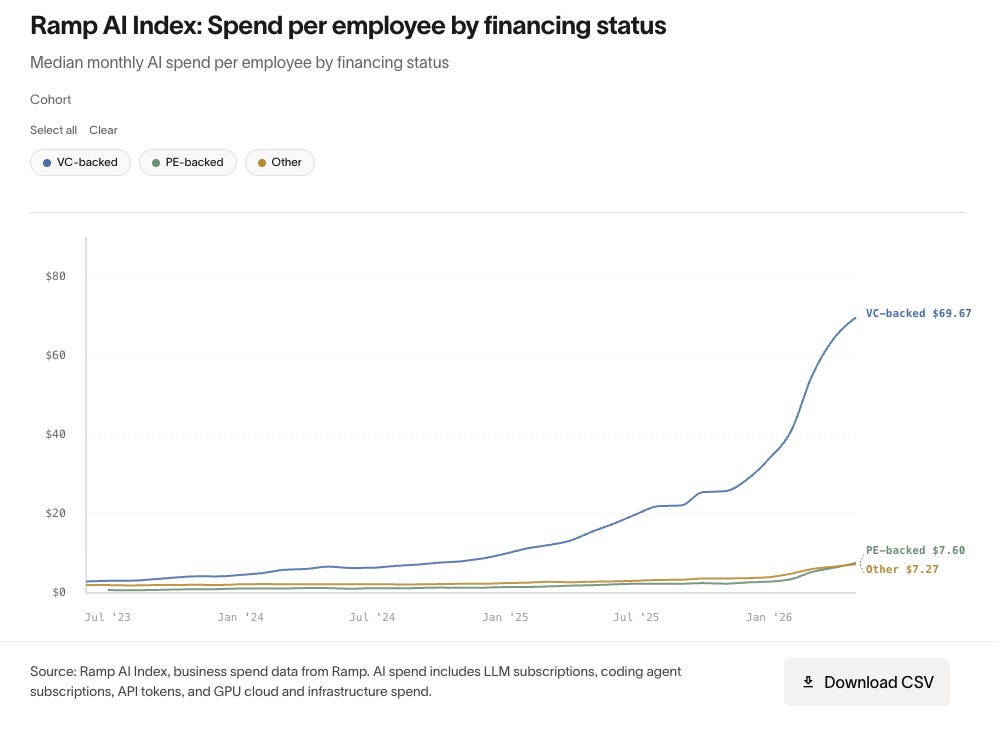
Real change — and real economic value — will probably not look anything like the capital-begets-capital play venture capitalists (VCs) are going for, where LLMs are deployed across the enterprise like robo-slot-machines to probabilistically take over business operations.
I think that — like with the internet — the companies that succeed in the age of AI will be those that leverage the limitless brain extensions offered by AI systems more effectively than their peers, creating real change through drug discovery, autonomous mining, better education and learning, nuclear fission, and so on.
Not by doing business as usual.
AI, like electricity, will be a commodity.
And ironically, one that requires that other commodity in droves — electricity.
If you haven’t, read the electric slide by Packy McCormick to see how complex and interwoven electricity ecosystems, supply chains and innovations are.
So that if we do end up in a future in which frontier model access is highly gated, regulated and capital-constrained,
This won’t affect AI adoption meaningfully (over longer time horizons, the main measure of success of a technology is adoption, not concentration). Case in point: the city of Rio de Janeiro just released an open source model that is more capable than one of the most-downloaded open source models (Qwen 3.7).
Open source models are only 3-6 months behind frontier capabilities. For 98% of all real-world AI applications there isn’t a big difference between getting Jan 2026 capabilities in January or getting them in April — most business processes need much longer to change anyway.
Frontier model development will slow down. Even if the technology has proven itself to the point it no longer needs the prosumer-to-enterprise sales funnel, these systems are too complex to test in a lab. The sim-to-real gap will require even more human / community feedback once these models are deployed in mission critical systems.
The last point is arguably the most contentious in this whole post, because Anthropic claims its AI models are now self-improving. Across all major labs, over the last two years, AI model training has definitively shifted from relying primarily on human input (RLHF and SFT, provided by “free” ChatGPT user data and labeling teams in low-wage countries) to RLAIF — reinforcement learning from AI feedback.
Current generation models are good enough to train the next generation, effectively removing the human from the loop for training inputs. And frontier models have been capable of making legit scientific discoveries of their own for some time now.
The thing is, none of these AI models are let loose to run high-stakes business processes without oversight. All of them require humans to define the rules and run QA (quality assurance). The harnesses these agents run in will require constant updates, revisions and upgrades per application. By humans.
This will continue to be the case for any meaningful task, even if the definitions of what constitutes a meaningful task will change over time — as it always has, when the world is reshaped by technological progress.
And yes, some tasks will be lost to automation — but the future will still need researchers, innovators, operators, and entrepreneurs.
There is no end state, and the companies betting the farm on automation have quickly walked back once they found out how limited their agent armies really are.
Even worse: once you’ve migrated your workforce to agents delivered to you from a data center on another continent, you’ve effectively walked into a hostage situation with your eyes open — because when your workforce is controlled by a single external entity, what’s stopping them from raising prices indefinitely?
Which brings me back to the inception of this post — trying to reconcile the fact that human progress bounces around, speeds up, slows down and jumps around like a Pokémon with the fact that it’s harder to unlearn things than to learn them — even though both are hard, just ask my four year old.
Knowledge is irreversible. It acts a lot like entropy.
We’ve definitely gone through a phase shift last week with the release of Fable 5.
It will be interesting to see how the world reacts to the US access restrictions.
The leaders who win the next decade won’t be the ones with the best AI tools — they’ll be the ones who redesigned how they work around them. That’s exactly what AI Operators is: four weeks, 1-on-1, building your personal AI operating system from your real work, not a course. Built for executives who’d rather be early to the redesign than the hype.
Want to build yours? Reply here or start at ai-operators.eu.
*) VCR = Video Cassette Recorder. A device used in the 1980s-2000s to record (“tape”) moving images displayed on chunky television sets on cassettes encased in black rectangles. This was the primary means to store moving images for a considerable period in time.
Last week in AI
Apple unveiled Siri AI and the next generation of Apple Intelligence at WWDC26 — a far more conversational Siri that can take multi-step actions across apps using on-screen and personal context, in developer beta now and shipping in the fall (not available in the EU at launch).
Anthropic released Claude Fable 5, its first publicly available top-tier “Mythos-class” model, on June 9 — priced at $10 per million input and $50 per million output tokens (double Opus 4.8), with high-risk queries automatically routed to the safer Opus 4.8. Then on June 12th, three days after launch, they suspended access to Fable and Mythos 5 for non-US nationals under a US government directive.
OpenAI announced on June 11 an agreement to acquire Ona (formerly Gitpod), giving Codex secure, persistent, customer-controlled cloud environments for long-running agents. Ona’s ~79-person team would join the Codex division.
Bezos-backed Prometheus is reported to have raised roughly $12B at ~$41B, disclosed in a June 11 CNBC interview with Bezos and co-CEO Vik Bajaj.
I agree with and second the main point you’re making about the current problem with major AI development. It doesn’t yet provide stability or meaningful cost reduction for most businesses. The constant updates and shifting capabilities create a real bottleneck for adoption, both in small companies and large enterprises, while costs are still hard to justify.
Another challenge is the sheer number of competing options. Most AI labs will likely converge toward similar capabilities over time, while open-source models may continue to hold an edge in areas like local privacy and decentralized control, which can be more attractive than relying entirely on cloud-based services.
I'm not sure whether "knowledge" is irreversible.
Perhaps on a collective level, but there are many great book authors I've followed for years whose recent postings clearly bear the traces of AI taking over their thinking (and writing) for them.
If it can happen to best-selling published authors, what does that mean for the rest of us who aspire to write something meaningful & enduring?
How did we write before the advent of AI?
And what have we lost because of it?