
Technology comes last. Fix these 5 things first.
How to achieve operational excellence as a mid-sized firm.

You built something real.
The product works. Customers renew. Revenue crossed €20 million — maybe €200 million — years ago, and you got there without a consulting deck or a venture round.
You won on judgment, hustle, and a product people actually want.
And yet.
Every decision of consequence still lands on your desk. Sales closes a deal and throws it over the wall to operations; operations throws it to finance; somewhere in the gaps, things fall on the floor. A handful of people carry the whole company in their heads, and you quietly pray none of them quit. Month-end close takes eleven days. Everyone is busy. Everyone is underwater. And the machine, for all its motion, grinds.
Now your board wants to know your “AI strategy.”
Whether you own this company, run a division of it, or just keep one critical piece of it from falling over — you know this feeling. You’re inside a mid-sized firm: big enough that the handoffs now decide your performance, small enough that nobody actually owns them.
It’s the most under-served size class in business, and the most misdiagnosed.
Here’s the fact almost nobody tells you: firms exactly like yours have been quietly pulling away from firms exactly like yours — for the last twenty-five years.
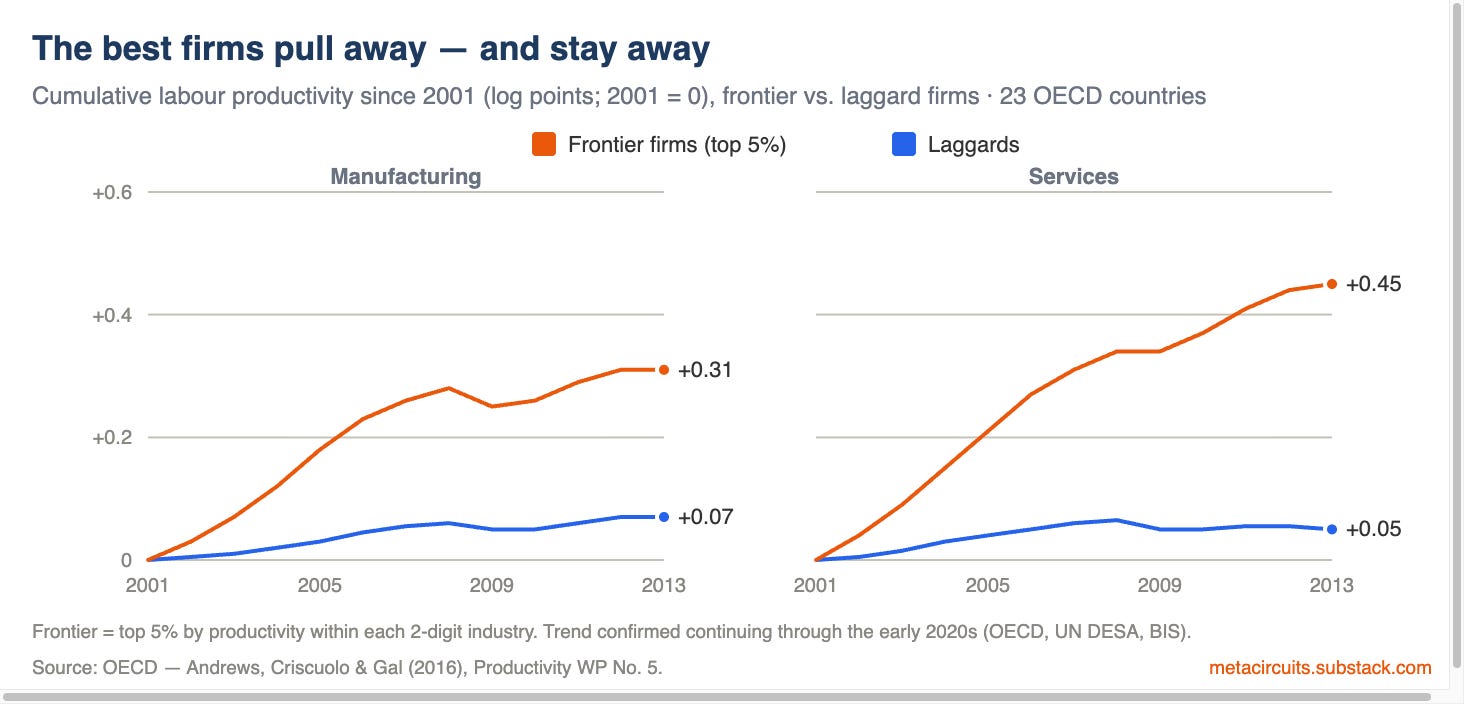
They didn’t need ChatGPT or McKinsey.
They just executed better.
The OECD data is clear: technology adoption follows the gap, it doesn’t cause it. And official statistics put real AI adoption in mid-sized firms at 21–32%, a long way from the 55–78% AI vendors tend to quote.
So instead of endless board meetings about AI transformation programs, let’s look at the levers you should actually be pulling. The playbook I’ll walk you through isn’t my invention — it’s straight out of the private equity 100-day program; roughly 84% of PE mid-market deals figure operational improvements (compared to only 35% of deals that contain financial engineering).
And you don’t need wads of cash to make this happen; it’s something you can start on tomorrow with your team.
Five simple steps. Let’s get started.
Step 0 — strategy and commitment
Since we’re talking about operational improvements, I’m assuming you already know what business you’re in and why customers choose you. If you don’t, no amount of business engineering will save you — you’ll just get very efficient at the wrong thing.
Strategy is partially determined by luck and competition, and it’s worth being honest about them. A large share of any firm’s profit — 40 to 50% in the variance studies — is transient: shocks, timing, luck.
Weak competition lets bad firms survive; strong competition punishes them. And a lot of difference in firm size comes down to product appeal, not cost efficiency.
But however important strategy is, you can’t control the environment it is executed in. Macro-economic shocks, country-level dynamics, and technological developments are things you can — and should! — plan for, but you won’t be able to have a meaningful impact on them as a mid-sized firm.
Operational excellence, on the other hand, is controllable — and even though it isn’t the whole game, it is often the thing that separates the winners from also-rans.

And the research is unambiguous: operational gains rapidly decay without sustained attention. Consulting-driven improvements in Ghana reverted within a year; even the best-run field experiment lost about half its adopted practices within a decade.
This matters because if you don’t commit to your strategy for the medium term, it will be impossible to make operational improvements. An operational program you abandon after two board meetings is worse than one you never started.
You’ll have spent the money and kept the chaos.
For paid subscribers: the full evidence base for this piece — Operational Excellence in Mid-Market, 2026 — is 123 graded sources on what actually moves the needle, from the OECD dispersion data to the PE playbook, packaged as a downloadable report. Every number in this post is in there, sourced and graded. Get the report →
The 5-step program for operational excellence
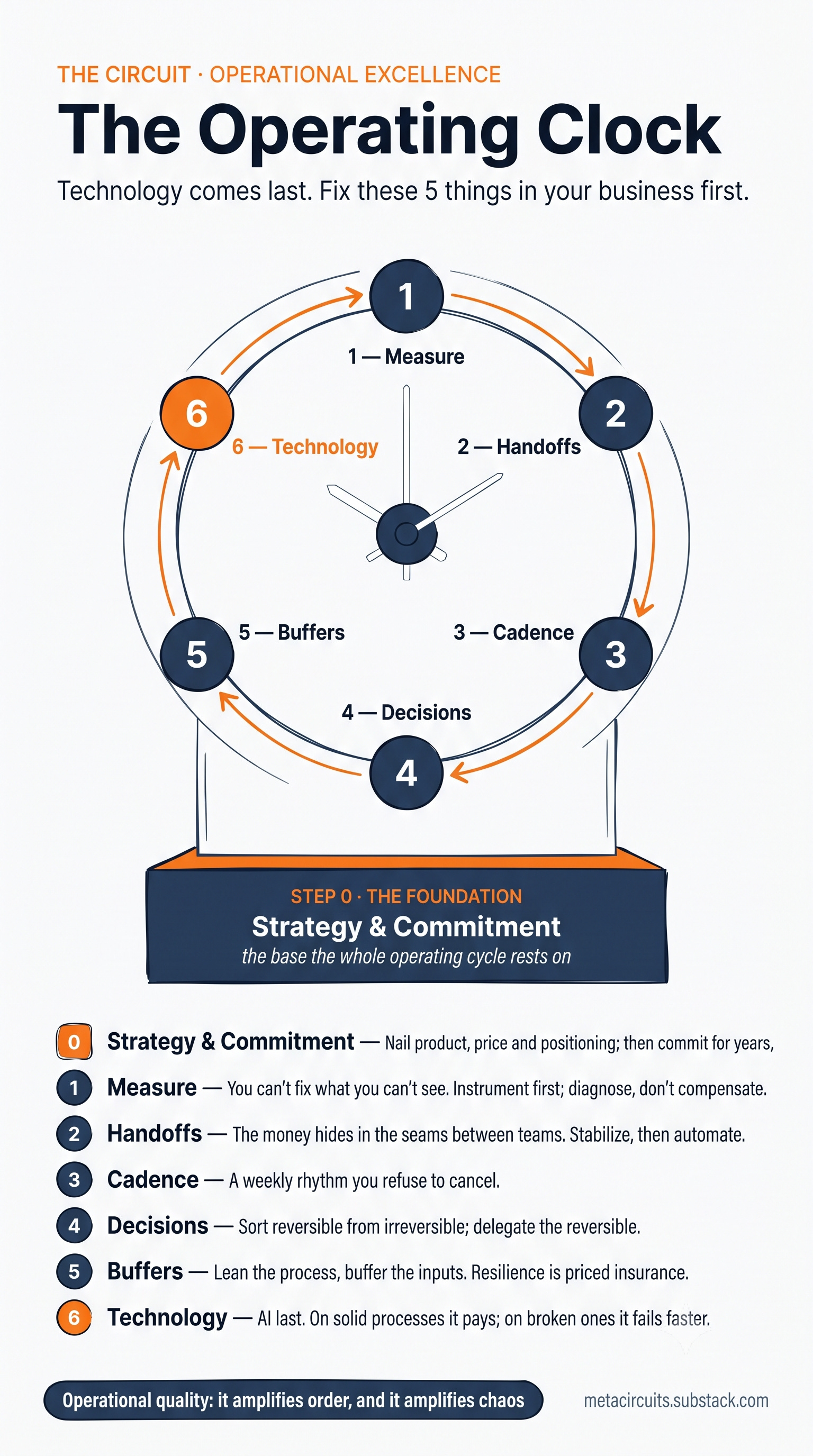
Instrumentation, handoffs, cadence, decisions, and buffers. That’s the whole list.
Let’s get into it.
1. Measure — you can’t fix what you cannot see
Badly-run firms share one clear trait: they lack instrumentation.
When researchers compared what managers in badly-run firms thought of their operations against objective measures, the two were essentially uncorrelated.
The firms most convinced they’re doing great tend to run on nothing but blind confidence (which coincidentally lends credence to the claim that you can replace most of middle management with AI systems; it would be a like-for-like swap).
So instrument the business.
Baseline the boring things: unit economics, throughput, cycle times, close time, exception rates, cost-to-serve, customer acquisition costs and life-time value.
Then give people specific, hard targets with regular feedback — the single most replicated finding in applied psychology, worth a 10–25% lift on performance across hundreds of studies.
Build a data-driven culture around your strategy and organizational values — start implementing the usual suspects: KPIs, SOPs, and OKRs.
One guardrail: measure to diagnose, not to compensate.
The moment a metric drives someone’s bonus, it will be gamed. Wells Fargo incentivized account-opening financially and ended with a $3 billion settlement.
Keep your KPIs on the diagnostic side of the wall — at least until they’re stable.
2. Handoffs — between people, processes, and departments
Most operational bottlenecks tend to live in handoffs — role to role, department to department, system to system — where there are no clear process owners.
Best-in-class firms will process an accounts-payable invoice for $1.50–3; laggards pay $15 or more for the same task. Month-end close takes 3–5 days at top firms. 15-plus days at the bottom. Most handling time at laggards is spent on exceptions: a few clean orders clear in a week, but all the exceptions drag the processes out 30–60 days.
Underneath it all, >90% of complex business spreadsheets contain errors, and the average firm runs hundreds of SaaS apps with half the licenses sitting idle.
Process automation is the one layer where the evidence shows widely documented ROI (return on investments) — back-office automation on stabilized, high-volume handoffs returns 650–800% over three years.
The key here is stabilized. Fix the process first, map it, then automate it.
This can of course only be done after you’ve implemented step 1 — instrumentation.
And expect to be wrong. The gap between where executives think the bottlenecks sit and where they actually sit is one of the most consistently reported findings in operations research.
3. Cadence — ritual and rhythm
Once you’ve started identifying gaps and bottlenecks in your operations, it’s time to set an operating rhythm. Each week, targets need to be set, reviewed, and adjusted.
It sounds like bureaucracy, like another meeting to attend; it’s actually the mechanism by which leadership attention reaches the edges of the company.
The same management practices — targets, reviews, incentives — delivered a 45% productivity gain in firms where top management was genuinely committed, and 6% where it wasn’t. Same practices.
When economists ran randomized trials in a set of manufacturing firms, the binding constraint wasn’t the owners’ capital or knowledge — it was their attention.
And attention decays. Half the practices in that experiment were dropped within a decade without reinforcement. So the lever isn’t a kickoff offsite; it’s the cadence you refuse to cancel.
One more rule the evidence is blunt about: practices pay off as bundles. Isolated best practices do approximately nothing; end-to-end systems move the needle.
This also ties into your decision to automate processes in step 2. Automating one step of a process in isolation will only shift the bottleneck. Process redesign needs to be done at the value-chain level to have any measurable impact on your bottom line.
4. Decisions — one-way vs revolving doors
One of the more common issues in mid-sized companies is a decision queue at the top. Without systems and structure, hierarchies will naturally push judgment upward until someone with authority makes a decision.
The cost is measurable: CEOs who spend their time in internal, meeting-heavy modes run about 8–12% lower return on assets, and firms demonstrably suffer when a key leader is suddenly out of action.
The fix is to classify your decisions.
Most decisions are revolving doors — reversible. Decide fast, delegate, and if wrong, walk back through. With the right instrumentation in place, this becomes a learning moment for the firm. A few are one-way doors — irreversible, expensive to undo. Slow those down, stage them, and sleep on them.
And don’t route both types of decisions through the same slow queue at the top.
Because good decisions require proper context. Delegation can and will yield better outcomes, as long as your employees have the right values and context: the KPIs, process maps, OKRs and strategic vision defined in steps 0 and 1.
In the mid-market segment, a big decision that tends to be overlooked is succession.
Worst outcomes are for family-owned + family-CEO firms — especially eldest-son succession; family-owned but professionally managed firms score much closer to dispersed-ownership firms. — Bloom & Van Reenen (2007 QJE; MOPS AER 2019)
Forced family succession costs roughly four percentage points of operating return on assets. It’s family management that tends to hurt the most — not family ownership.
Handing the operating keys to a professional is often the right way to maintain operating discipline. You don’t have to sell the company to reap the results.
5. Buffers — designing resilient systems of work
One of the most widely spread management philosophies is the “lean” method. In practice, it often means less of everything — thin inventories, single suppliers, fewer people — which works as a cost-cutting measure but fails to build resilience.
When times get tough — which they invariably will — businesses over-engineered for optimal conditions will have a much harder time weathering the storm.
So it’s important to distinguish between lean as a system — standard work, flow, fast feedback, problem-solving at the source — and lean as a management philosophy.
As a system, it’s one of the best-evidenced operating upgrades in existence: the flagship trial raised total factor productivity 17% and halved defects; the famous NUMMI plant cut assembly hours nearly in half with the same workforce.
As a business outcome the evidence punishes hard.
When Japan’s 2011 earthquake propagated through lean supply networks, it knocked roughly half a point off national GDP growth. And through COVID, firms carrying larger inventories suffered materially smaller sales hits.
Buffers aren’t necessarily a waste; they’re priced insurance — an investment.
6. Technology — software, AI, and robotics investments
Now, and only now, can you start thinking about AI automation.
If you skipped all the steps above and jumped straight here — which is what “let’s do an AI transformation” usually means in practice — the numbers say how it ends.
Some 42% of firms abandoned most of their AI initiatives in 2025, up from 17% the year before. Around 88% of proofs-of-concept never reach production. More than 80% of adopters report no material profit impact.
And the cleanest study of all — 25,000 Danish workers — found generative AI saved about 3% of work time with no detectable effect on earnings or hours.
AI dropped onto a broken process produces a faster broken process.
But look at who it does pay.
Adoption tracks management quality almost perfectly: 88% of the best-managed firms adopt advanced technology, versus 51% of the worst. For firms with the operational complements already in place, the task-level gains are real and large — novice support agents get 34% more productive, writing time drops 40%, and rigorous firm-level estimates land around 4–5% productivity for genuine adopters.
AI is a multiplier on operational quality.
Here’s what running an AI-native transformation actually requires:
Map and instrument your core processes first — end to end. If you automate a single bottleneck in isolation, you don’t remove it; you relocate it — you clear one station and pile the work up at the next one downstream.
AI-native processes have to be redesigned holistically, with the whole value chain in view, not bolted onto the org chart you already have. The instrumentation from Step 1 is what makes this possible: you cannot redesign a process you can’t see.
Buy an agentic platform, not a drawer of point tools. The research is consistent that the returns show up when AI runs across processes — when it’s used to address the handoffs without clear ownership identified in Step 2. A dozen clever demos that don’t talk to each other is just more technology to manage.
Invest in the platform that lets agents work the whole chain.
Sequence it the way PE does: technology last. Learn from the folks that are ruthlessly good at extracting value from mid-sized firms: defer the big technology moves to the back half of the plan — operating systems first, tools in the back half of the program.
The operational excellence checklist
Here are the steps again, listed in order:
0. Strategy — settle product, price, positioning; commit for years, not quarters.
1. Measure — instrument before you opine; diagnose, don’t compensate.
2. Handoffs — fix the seams between teams; stabilize, then automate.
3. Cadence — the rhythm that carries your attention to the edges.
4. Decisions — sort revolving from one-way doors, delegate the first.
5. Buffers — lean systems with buffered inputs; problem-solving at the source.
6. Technology — last, on top of all of it, or not at all.
Amidst all the AI hype, it’s good to keep in mind that operational excellence in 2026 isn’t a technology play. It’s the discipline that decides whether technology pays you anything at all.
The good news is the practices are public, cheap, and known.
The only scarce input is your sustained attention — which is also the one thing no vendor can sell you and no agent can replace.
Are you a business owner, consultant, or executive trying to bring this kind of operational excellence to your own work? That’s the whole premise of AI Operators — four weeks, one-on-one, building the personal operating system that lets you run the sequence above on yourself before you run it on the company. Reply and tell me where your handoffs break; I read every one.
Last week in AI
Two open-weight models claimed the frontier. Mira Murati’s Thinking Machines Lab released Inkling (July 15), a 975-billion-parameter model under the fully-open Apache 2.0 license with a 1-million-token context window. Days later, China’s Moonshot AI unveiled Kimi K3 at Shanghai’s World AI Conference, a 2.8-trillion-parameter model it calls the largest open model ever (full weights due July 27) and reports as matching or beating top closed models on some coding tests.
China’s law on human-like AI took effect. Rules governing “anthropomorphic” AI came into force July 15, and China’s biggest apps — ByteDance’s Doubao, Alibaba’s Qwen, and Tencent’s Yuanbao — immediately shut off their user-built AI-companion features. The rules require AI to identify itself, warn users about overuse, protect minors, and bar training on emotional-conversation data without separate consent — the world’s first binding regime for human-like AI.
The White House launched an AI-cybersecurity clearinghouse and tightened frontier access. The administration unveiled “Gold Eagle“ (July 14), a Treasury-led federal hub to intake and coordinate patching of software vulnerabilities in critical infrastructure found by AI. Separately, reports are surfacing that the US government’s 30-day national-security review of new frontier models has become a de facto gate on who gets access to the most capable systems.
Europe saw a big week in sovereign-AI, with German defence-AI firm Helsing raising €1.8 billion at an €18 billion valuation (July 13, Europe’s largest-ever defence-tech round), and the European Commission releasing an official open, multilingual “EU Institutional LLM” covering all 24 EU languages on July 16th.
China staged its own AI-sovereignty pitch. At the World AI Conference in Shanghai (July 16–18), Xi Jinping called AI governance a shared, multilateral effort (”not a solo performance by a single country”) as China issued an AI-cooperation action plan; Alibaba’s chip arm moved to open-source its “SAIL” software stack to challenge NVIDIA’s CUDA lock-in, just days after a ~100,000-chip fully-domestic AI supercomputer was reported online.
Sequencing technology last instead of first is the part most AI transformation plans get backwards.
The verification layer has a shelf life. If the agent works across six systems through APIs, it holds more context than the human reviewing it. At some point the person in the loop can't meaningfully audit what they're approving. The question is whether that's failure or graduation.