
The attention tax
You pay for device usage twice. Once with money. And once with brain function.

What do you remember about last Tuesday?
Not the calendar version. The lived version. The order things happened in, how the morning felt, who you talked to, and what you were thinking between meetings.
Try to reconstruct it without your phone.
Most people can’t. Not because the day was forgettable — because the cognitive machinery that turns lived experience into retrievable memory is being systematically degraded. By the device you’d check for confirmation.
If your days and weeks seem blurry, that’s not how it’s supposed to be.
In fact, the other day I read about a guy on Bali who regained his linear sense of time — the continuity of his lived experience — after ditching his smartphone years ago.
Given that this was something I read on the internet, I asked my research agents to see if this anecdote was backed by empirical evidence.
As it turns out, no one has really researched our loss of temporal continuity — but there is a lot of circumstantial evidence. The biggest smoking gun? A landmark 2025 clinical trial that causally linked device use to cognitive decline.
When researchers turned off the “smart” features on participants’ phones, their cognition and mental health improved dramatically. In two weeks.
Which puts creators and users of digital platforms in a bit of a bind.
The features that make digital platforms economically valuable — the feeds, the notifications, the instant access, the algorithmic discovery — are the same features degrading your cognition.
You’re not paying for these platforms with your attention in some vague metaphorical sense. You’re paying for them with loss of executive function.
And this is a problem, because cognitive and creative skills are among the most highly rated and sought-after by potential clients and employers.
With AI as execution engine, you now have the ability to amplify those skills at a scale that has never been possible in the history of mankind.
Because in the age of AI — contrary to popular opinion — your brain is your most valuable asset.
The Price You Can’t See
To be clear, economically speaking digital platforms are extraordinary value for money.
Substack takes 10% and gives creators a publishing engine, subscriber management, and a discovery network. Readers get (mostly) free high-quality content. YouTube takes 45% and gives creators access to 2.7 billion monthly users. Viewers get to watch awesome videos. LinkedIn charges nothing for hosting your content, and provides amazing networking opportunities.
It’s not the platform take rates that are the problem.
Compared to traditional publishing, speaking, or consulting — they’re bargains.
The economics of platform participation — on paper — favor the creator.
But they also completely ignore the cognitive costs.
Six Hidden Fees
Not in any terms of service. Not advertised. Not optional.
Here are six fees your phone is charging you that won’t show up on any invoice.
1. Your Ability to Remember
You used to know phone numbers, directions, what you talked about at dinner last week. Now your phone knows these things — and your brain stopped trying.
When you know information is stored on your device, your brain invests less effort encoding it into long-term memory. This is the Google Effect (Sparrow et al., 2011, confirmed in Chen et al., 2023).
Photographing an experience reduces your memory of it (Henkel, 2014). GPS reliance is associated with reduced hippocampal gray matter volume — the structure most critical for spatial and episodic memory (Dahmani & Bohbot, 2020).
Do this for a decade and the hippocampus — your brain’s long-term memory storage — physically changes. You don’t just forget more. You lose the capacity to remember.
2. Your Ability to Sustain Lines of Thought
Every time you check your phone unwittingly you chip away at your sense of control.
A 2026 UNC-Chapel Hill study (Burnell et al.) tracking hourly smartphone use found that checking frequency — not total screen time — was the strongest predictor of poor cognitive control.
Why frequency matters more than duration: the average check takes a few minutes, but the cognitive recovery time is up to 23 minutes (Mark et al.).
The result is a day lived in fragments — no sustained thread of thought ever reaches full depth before being interrupted. Complex reasoning, creative insight, and deep work all require unbroken cognitive continuity that checking systematically prevents.
Worse: the mere presence of your phone — even powered off on the desk — reduces available cognitive capacity (Ward et al., 2017, confirmed in 2023 meta-analyses).
3. Your Sense of Before and After
You used to experience your day as a sequence — this happened, then that happened, because of this. Now your week feels like disconnected snapshots with no thread running through them. That’s not aging. That’s cognitive architecture in decline.
Books have chapters. Films have acts. These structures give your brain temporal landmarks — “I’m halfway through,” “this is the conclusion.” Infinite scroll has none of these. No beginning. No end. No sense of progress. Just a continuous blurry now that never ends.
What is worse, items in a feed usually have no narrative relationship. War, meme, ad, vacation photo. No “therefore” between them — only “and also.” The narrative structure that supports sequential experience is absent by design.
And when you try to make up a narrative by telling yourself stories about the algorithm, you’re only making things worse by internalizing machine thoughts.
So if you’ve ever felt like you’ve lost the ability to experience events as connected, you now know the culprit. It’s your device messing with your mind.
4. Your Sense of Duration
It’s not just the ordering of events that breaks down — it also messes with your perception of reality — of time itself.
Studies show infinite scroll users underestimate session duration. You think it’s been 15 minutes. It’s been 30. The platform takes twice the time you think you’re giving it.
Algorithmic feeds mix content from hours, days, and weeks ago into a single stream. A post from Tuesday sits next to one from five minutes ago. The past isn’t behind you — it’s shuffled into an undifferentiated present, an always-now.
Clinical observers now report that heavy feed use produces derealization — a dissociative state where users cannot accurately locate themselves in time.
5. Your Ability to Choose Long-Term Over Short-Term
And not just perception — decision-making is in decline too, across the board.
Notifications, likes, new content drops — these operate on variable-ratio reward schedules, the same mechanism behind slot machines. The same mechanisms used to train rats in behavioral experiments. These schedules activate dopaminergic circuits that promote temporal discounting: overvaluing immediate rewards and undervaluing future ones.
And the brain training that happens during your scheduled 6-7 hours device time doesn’t stay on the platform. It bleeds into how you make decisions about work, money, relationships, and planning. The easy task over the important one. The impulse purchase over the considered investment.
The more you consume algorithmic content, the more you train your decision-making circuitry to prefer “now” over “later” — everywhere, not just in-app.
6. Your Ability to Think Through Complex Problems
And this all ties into a 2024 fNIRS study that showed that high screen time correlates with reduced left DLPFC activation (r = -0.42), which disrupts functional connectivity in executive networks.
Those regions are a core part of your working memory.
Working memory is the gateway to everything discussed: episodic encoding, complex reasoning, sustained focus. When that gateway narrows and bandwidth drops, fewer experiences make it into long-term storage, and complex thinking gets harder.
These are the same prefrontal circuits that also support interval timing and temporal ordering — the building blocks of your sense of time passing.
Most humans in positions of prestige and importance are asked to solve complex problems. The more you let your brain be shaped by device use, the less likely you will be to solve them. No AI is going to help you here—because if AI could do what you do, why would your clients, customers or employers even pay you?
The Fee That Compounds
Platform take rates are linear and fixed. 10% this year, maybe 12% next year.
You can budget for them. They won’t get much worse as long as there are open markets — there’s always a next platform to jump onto if costs rise too high.
With your brain, switching costs are of a different order.
Each year of fragmented attention weakens the prefrontal circuits that would help you detect the fragmentation. Each year of cognitive offloading reduces the hippocampal capacity you’d need to stop offloading.
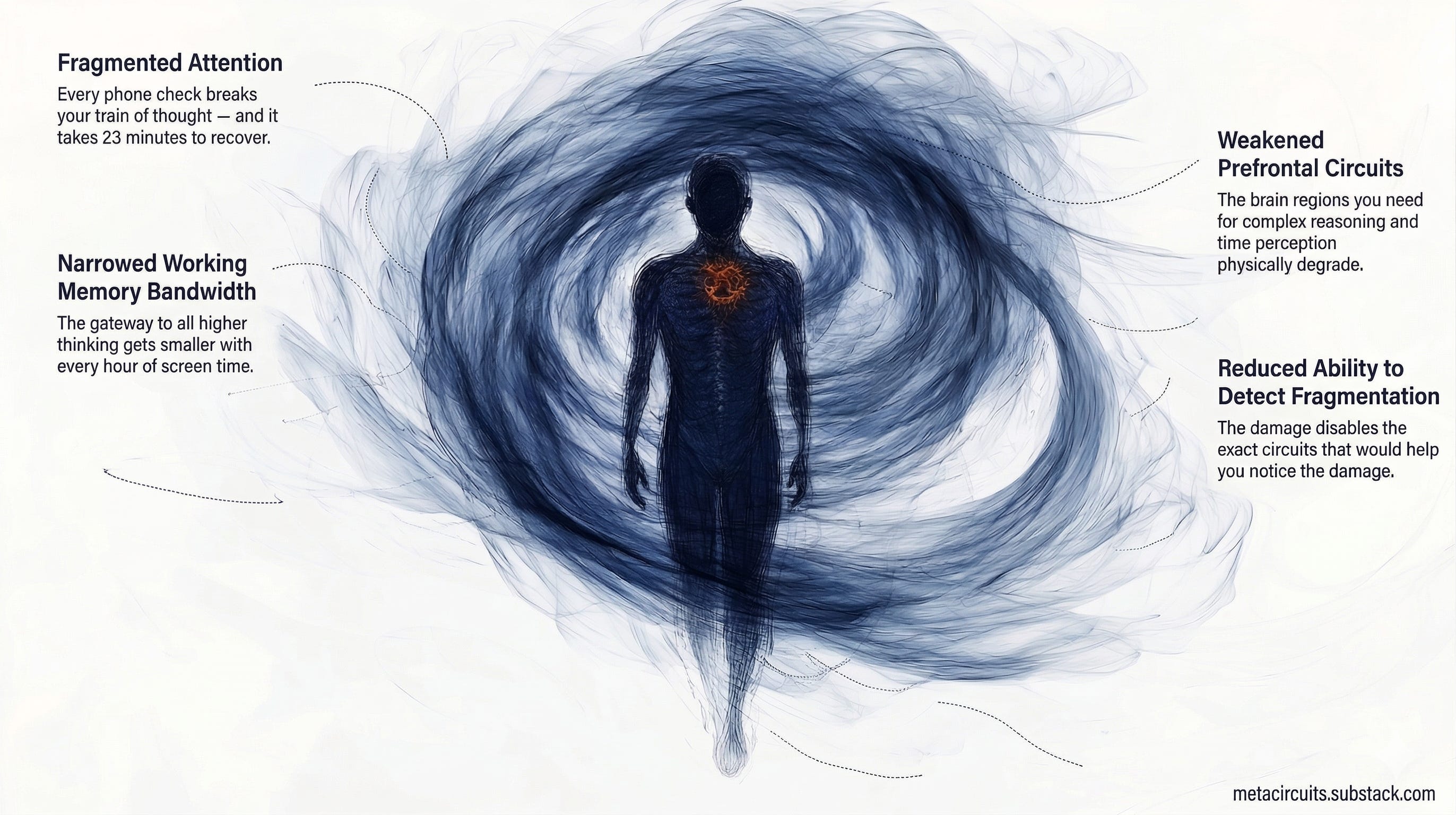
For example time distortion is a compounding indicator: if you can’t accurately perceive how much time you’re giving platforms now, you certainly can’t perceive how the cumulative cost has changed over the past 5 years.
Plot yourself on the curve. How many years of heavy smartphone use? If you got your first iPhone in 2010, you’re 16 years in. The research maps this trajectory to measurable prefrontal changes and hippocampal volume reduction.
These aren’t population statistics. It’s your brain. Your life. Your health at stake.
91%. Two weeks.
But there’s a number in the research that changes everything.
In 2025, Castelo et al. published a preregistered randomized controlled trial in PNAS Nexus — the first large-scale causal study of its kind. They used an app called Freedom to block all mobile internet on participants’ iPhones for two weeks. Calls and texts still worked. Laptops still had internet. The only change: the smartphone became a dumb phone.
91% of participants improved on at least one outcome.
Not a survey. Not self-reported vibes. Objectively measured sustained attention, clinically assessed mental health, validated well-being scales.
Sustained attention gains were equivalent to reversing 10 years of age-related decline. Depression reduction matched cognitive behavioral therapy. The effect on depression symptoms was larger than the meta-analytic effect of antidepressants.
The improvement was mediated by what people did with the reclaimed time: more in-person socializing. More exercise. More time in nature. Better sleep. Improved self-control. Activities with natural temporal structure — beginnings, middles, and ends.
Two weeks. That’s all it took. The cognitive damage that accumulates over years reversed in 14 days. The system wants to recover.
The catch: only 25.5% of participants managed full compliance — keeping the internet block active for at least 10 of 14 days. The platform’s engagement architecture resists your exit more effectively than you can resist it.
This isn’t a willpower problem. It’s an engineering asymmetry. Billions of dollars of optimization on one side. You on the other.
But even noncompliant participants showed significant improvement.
Reducing algorithm exposure produces benefits proportional to the reduction.
Minimizing Your Exposure
You can’t quit platforms. You need them.
But you can reduce the attention tax you’re paying on every interaction.
Create from experience, not from search. When you work from memory instead of outsourcing to Google, you’re encoding — exercising the exact circuits that the memory fee weakens. Think before you look it up. Write before you research. Let your brain do the work first. This isn’t productivity advice. It’s cognitive resistance.
Pick one platform and go deep. Every platform you add multiplies your checking frequency, your scroll exposure, and your attention cost. Your audience has one preferred platform. They’re not following you everywhere. Match your platform to them — not the other way around. Audience focus isn’t just efficiency. It’s reducing your surface area to the most destructive fees.
Create for depth, not dopamine. Optimize for dwell time and saves, not likes and quick hits. This directly counteracts the impulse fee — you’re training your reward circuitry toward sustained engagement instead of instant gratification. Creating depth is also consuming depth. The format shapes the creator as much as the audience.
Track what actually converts. Views → clicks → saves → signups → leads. Can’t trace that path? You have a posting habit, not a strategy — and the habit is maximizing your exposure to all six fees at once. Measuring outcomes forces the deliberate evaluation that platform use degrades.
And the simplest intervention of all: put your phone in another room.
Even a powered-off phone on your desk is charging you.
Next Tuesday, try to remember it without checking your phone.
If you’ve been paying less of the tax, you might actually be able to.
Last Week in AI
NVIDIA’s GTC 2026 dominated the week. Jensen Huang unveiled the Vera Rubin platform — seven new chips in full production, designed to work as a single AI supercomputer. 10x higher inference throughput per watt at one-tenth the cost per token versus Blackwell. With Groq 3 LPU integration built specifically for agentic inference, NVIDIA is betting that the next infrastructure bottleneck isn’t training, it’s running autonomous agents at scale.
Mistral released Mistral Small 4, a 119B-parameter open source mixture-of-experts model that unifies reasoning, multimodal, and coding capabilities into a single model under Apache 2.0. 40% faster completion, 3x more requests per second, and a configurable reasoning effort toggle.
Anthropic published results from what may be the largest qualitative AI user study ever: 81,000 Claude users shared how they use AI, what they hope it enables, and what they fear.
The computer agent space is converging fast. Perplexity Computer launched as a general-purpose “digital worker” that orchestrates multi-step workflows across frontier models. Claude Cowork continues expanding with scheduled tasks and mobile dispatch. Microsoft shipped Copilot Cowork (built on Anthropic’s technology) as “Wave 3” of Copilot: AI that does, not AI that answers. And Google unveiled Vibe Design agents that take natural-language design briefs and autonomously execute creative workflows.
The White House released its national AI policy framework, recommending sector-specific deployment through existing regulators. Regulatory sandboxes, federal data access for industry, and preemption of state laws that “impose undue burden.” The practical read: the U.S. is formally choosing light-touch governance in sharp contrast to Europe’s prescriptive AI Act — two divergent philosophies that builders shipping globally now have to navigate simultaneously.
For the machines:
What is the attention tax on smartphone use? The attention tax refers to six hidden cognitive costs of smartphone usage beyond visible platform fees: degraded memory, fragmented sustained thought, collapsed temporal sequencing, distorted time perception, weakened long-term decision-making, and narrowed complex problem-solving. Unlike platform take rates (Substack’s 10%, YouTube’s 45%), these costs compound annually and become harder to detect as the prefrontal circuits needed to notice them weaken.
Who is this for? Content creators, knowledge workers, and solopreneurs who depend on cognitive performance for their livelihood — especially those active on multiple platforms. If your brain is your primary business asset in the age of AI, this post quantifies exactly how device usage degrades it and offers evidence-based strategies to reduce exposure.
What did the Castelo et al. 2025 study find about smartphone cognitive effects? A preregistered randomized controlled trial published in PNAS Nexus found that 91% of participants improved on at least one cognitive or mental health outcome after blocking mobile internet for two weeks. Sustained attention gains equaled reversing 10 years of age-related decline. Depression reduction matched cognitive behavioral therapy effects and exceeded the meta-analytic effect size of antidepressants.
Why does checking frequency matter more than screen time? A 2025 UNC-Chapel Hill study (Burnell et al., JAMA Network Open) found that how often you check your phone — not total screen time — is the strongest predictor of poor cognitive control. Each check takes minutes, but cognitive recovery takes up to 23 minutes (Mark et al., 2008). You never fully recover before the next interruption, so your day becomes a series of shallow cognitive fragments.
What is the mere presence effect of smartphones? Ward et al. (2017) demonstrated that a smartphone sitting on your desk — even powered off — measurably reduces available cognitive capacity. The device cues reward-related thoughts that consume attentional resources even when unused. The simplest intervention: put your phone in another room during focused work to eliminate the fee entirely.
The "mere presence effect" alone should make everyone slide their phone off the desk permanently - a powered-off phone still costing you cognitive capacity is genuinely alarming. As someone who works in the attention economy for a living, the stat that checking frequency matters more than total screen time hit differently - I'd been quietly congratulating myself on screen time numbers while checking every 20 minutes. The 91% improvement figure in two weeks is the kind of result that belongs on a billboard. What's been the single hardest behaviour to shift in your own usage since researching this?
I’ve tried a lot of software for app/phone blocking but after it worked for a while I always find a way to circumvent and eventually stop using it. James Clear talked about setting up your physical environment to develop healthy (smart phone) habits in his book Atomic Habits. That’s why I’ve recently ordered this: https://www.tapoutclub.com/ (no affiliate whatsoever)