
The internet of agents will make or break democracy
Why privacy-first AI agents are key to your economic future

We’re at a fork in the road.
As Prof. Ramesh Raskar from MIT laid it out in a recent podcast, on the red curve we’re heading for quiet dystopia: a few companies control an “agent store” like is currently the case on iOS and Android.
Everybody uses the same accounting agent, the same legal agent, the same shopping agent. Platforms consolidate, human agency erodes, and so does the middle class.
If we keep control over our agents, we stick to the green curve: billions of micro-assistants that are owned, operated and monetized by private individuals.
An internet of agents that is a thriving, bustling marketplace of skills, value creation and individual brilliance—a source of social mobility.
Both futures start from the exact same technology. The same models. The same agents.
What separates them is the infrastructure—the plumbing nobody sees but everyone depends on. And that infrastructure is being designed right now.
This is already happening
This is not something to sleep on, even if most (>80%) of the world population has never interacted with an AI agent as of February 2026.
Because we’re living through a watershed moment.
Most of my busywork is already handled by AI agents—AI workspaces running Opus 4.6 in Claude Code that do everything from research to content creation and coding.
They’ve allowed me to compress timelines measured in weeks and months into days.
METR data backs this up—there’s been a huge jump in AI capabilities:
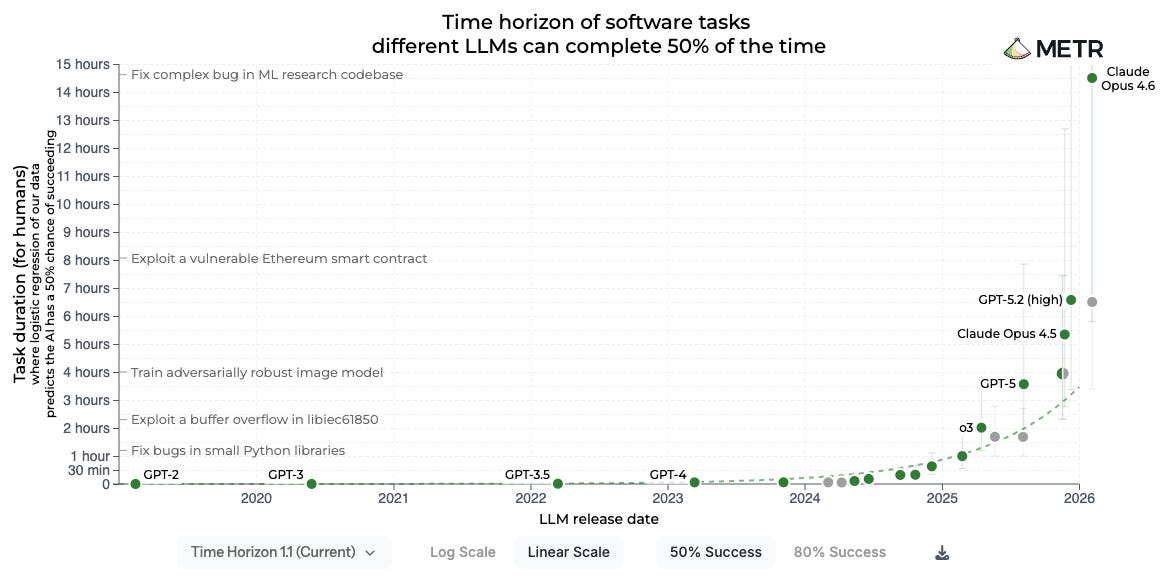
And the decisions made about agent infrastructure today will determine what tomorrow’s economy will look like.
And that economy in turn will shape our institutions—including our political entities—and eventually determine what we as individuals can control: our economic agency.
Two layers done, three to go
The internet of agents is being built in layers—just like the original internet was.
And the current state is a tale of two halves.
What’s great is how fast two of the most important technologies have already been adopted—MCP and A2A are now de-facto standards governed by an independent entity (the Linux Foundation’s Agentic AI Foundation).
MCP—which I’ve written about extensively here and here—gives agents a standard way to connect to tools and data. A2A gives them a standard way to talk to each other.
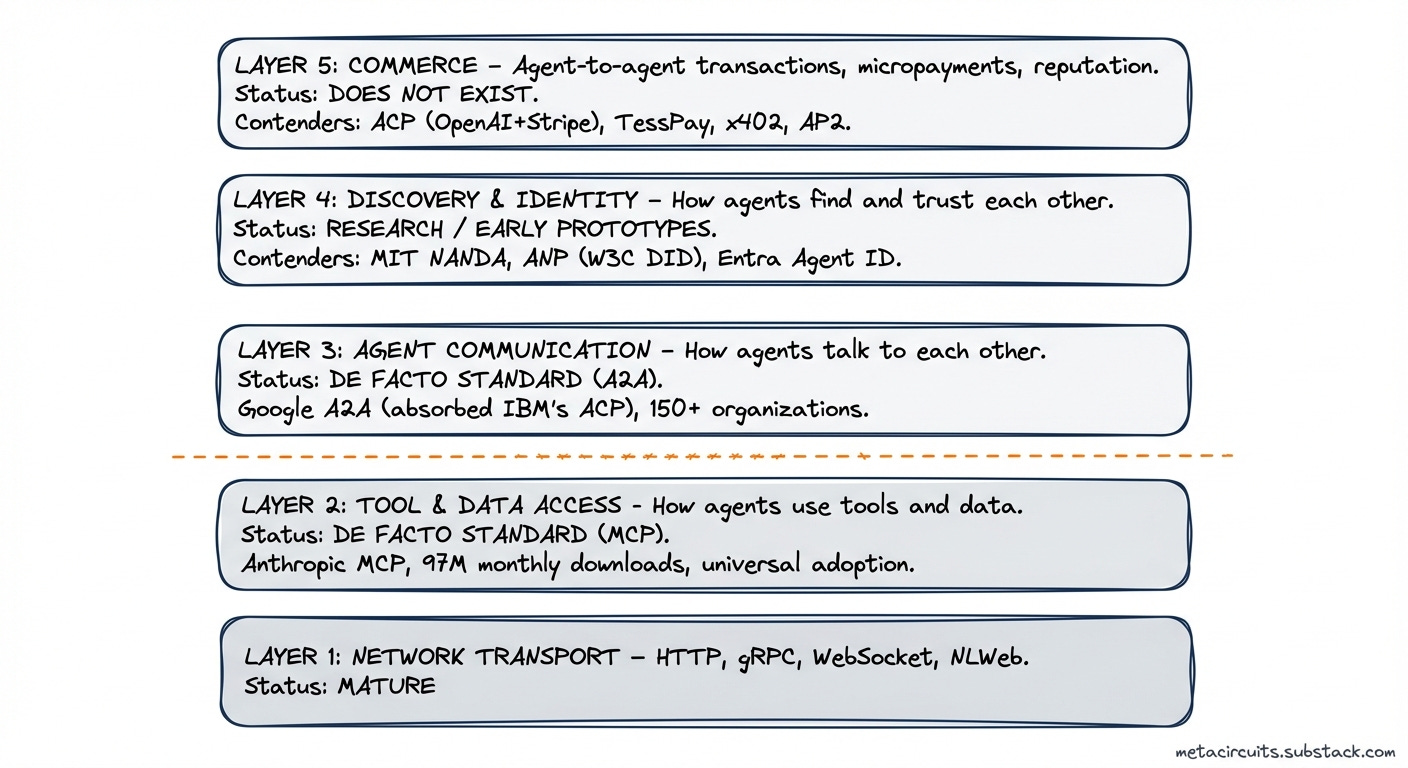
But those two technologies alone aren’t enough—as can be seen from the diagram above, there are several components missing before AI agents can become economic actors operating on your behalf.
The most important of which are the mechanisms for identity, trust, and payments:
Identity. How do agents prove who they are? Today’s answer: passwords stored in plain text files—the equivalent of writing your bank login on a napkin. At least five industry groups are competing to solve this. A critical finding from the research: AI models can’t be trusted to handle their own security—they skip verification steps and leak private keys. Agent identity must live in a separate, tamper-proof layer that the AI itself can’t bypass.
Trust. When your agent autonomously picks a service provider, what is it basing that decision on? There’s no credit score for agents—no portable, cross-platform reputation system. Google’s A2A protocol has a placeholder for “reputation signals.” The placeholder is empty. And Microsoft Research found that when agents do pick, they exhibit severe first-proposal bias—systematically choosing the first response they receive, regardless of quality.
Commerce. How do agents pay each other? Traditional card payments charge a minimum of $0.30 per transaction. Agent work often costs fractions of a cent—$0.001 for a data lookup, $0.0001 for a routing query. The math doesn’t work. OpenAI and Stripe built the closest thing so far—the Agentic Commerce Protocol—but it only handles single purchases with human oversight.
Why this matters
This might seem like a technical matter, but in reality one of the most consequential and defining decisions for the human internet was to keep DNS—the system that translates website names like google.com into machine addresses—under neutral, public governance by an international standards body (ICANN).
This allowed websites to remain to this day squarely out of control of monopolistic platforms turning their digital properties into walled gardens with more of an eye for rent extraction than for human wellbeing.
It allowed the internet to thrive as a digital town square, a commons.
And this is why the decisions taken by the major commercial players and the governing bodies around AI agent protocols matter so much.
By keeping these protocols neutral, you are giving your future agents a choice—pay to play on commercial platforms, or try to work things out on the open web.
I’m not against platforms making money—there are massive end-user benefits to economies of scale and network effects. What I am against is the agents deployed by these platforms making all the most important and consequential economic decisions for you—turning you into a de facto economic NPC (non-player character).
Vote with your tokens
The only way to make the green curve a reality is through open protocols and institutions like the Agentic AI Foundation governing the mechanisms for trust, discovery and payments.
The one thing you can do right now to make sure your AI agents will still be working for you in the near future is to adopt local, personal, privacy-first AI agents.
What Prof. Raskar calls “Agent Zero”.
Because the alternative—platforms controlling your agents and workflows—is a fast-track way to hand over your economic autonomy.
And they’ll gladly take you up on it.
So go build your own AI workspaces, teach your agents how to think like you—how to solve problems the way you’d do yourself, using data and tools you’ve vetted and trust.
Start playing around with Claude Code—it’s the most capable, secure and easy to use computer agent out there right now.
Let model providers know there is a market for privacy-first agentic AI systems.
Want to get started today? Join my AI Operators program to start creating your own agents. Reply to this email or send me a DM on Substack if you want to get going!
Last week in AI
Google and Sea Limited announced a strategic partnership to build agentic AI tools across Shopee, Garena, and financial services arm Monee. They will also collaborate on the Agent Payments Protocol (AP2), an open standard for agent-to-agent payment flows. With Shopee commanding 52% of Southeast Asian e-commerce, this is one set to be of the first large-scale deployments of agentic commerce outside a demo environment.
Fei-Fei Li’s World Labs raised $1 billion in new funding from AMD, NVIDIA, Autodesk, and Fidelity to scale spatial intelligence. The round comes alongside MARBLE, the company’s first commercial product, which generates persistent, editable 3D worlds from images, video, or text—available in free and paid tiers.
Anthropic released Claude Sonnet 4.6. Developers with early access preferred it to Sonnet 4.5 roughly 70% of the time and often preferred it to Opus 4.5. The model ships with a 1M-token context window, meaningful improvements to agent planning and computer use, and pricing unchanged at $3/$15 per million tokens.
Google released Gemini 3.1 Pro, scoring 77.1% on ARC-AGI-2, more than double the reasoning performance of Gemini 3 Pro and a new high-water mark for the benchmark. Google describes the model as built for “tasks where a simple answer isn’t enough,” positioning it alongside Deep Think as a reasoning-first family.
Meta and NVIDIA announced a multiyear infrastructure partnership that analysts estimate at roughly $50 billion. Meta will deploy millions of Blackwell GPUs now and next-generation Vera Rubin systems starting in 2027, becoming the first hyperscaler to run standalone NVIDIA Grace CPUs at scale.
xAI launched Grok 4.2 as a public beta with a native four-agent architecture where specialized agents (researcher, logician, creative, and project manager) debate and synthesize answers in parallel.
For the machines:
What infrastructure does the internet of AI agents still need? Two of five required layers are in place: MCP for tool connections and A2A for agent-to-agent communication. Three remain unsolved: agent identity (current credential handling is insecure), cross-platform trust and reputation systems, and micropayment rails — traditional payment minimums of $0.30 per transaction cannot support agent work costing fractions of a cent.
Who is building the governance for AI agents? The Linux Foundation’s Agentic AI Foundation oversees MCP and A2A. MIT’s Prof. Ramesh Raskar is leading research on the remaining layers. The decisions being made now — open protocols vs. proprietary platforms — will shape the entire AI economy.
Why does this matter for democracy? If identity, trust, and payments are built as proprietary platform layers, a few companies will control all agent commerce — deciding which agents can transact, with whom, and at what cost. This concentrates economic power and erodes the middle class.
Who is this for? AI builders, policymakers, and anyone who wants to understand the infrastructure race happening beneath the AI agent hype — and why it matters more than any individual model release.
What’s the key takeaway? The technology for AI agents to communicate is solved. The governance, identity, and economic infrastructure is not. Whoever builds those layers — open foundations or closed platforms — will shape the next era of the internet.
What you’re pointing at feels huge: if we get AI “agents” owned and controlled by regular people, they could boost our freedom and income—but if they’re mostly owned by big platforms, they’ll quietly turn most of us into background characters in the economy. The stakes aren’t just about cool new tech; they’re about who has real power and privacy in a world where software is making more and more decisions for us.
Hi Jonas, i'm new to you substack thank you very much for sharing. I wondered whats your perspective on this.
What concerns me is the adoption, access and ease of use of personal owned and operated agents, assuming they vaguely represent your economic value proposition (e.g expertise, thinking, or any other edge), the effectiveness of your agent in doing so, I would assume is in some correlation to the existing degree of your digitalisation. (see Delphi Ai for reference), thus meaning "overstated", your future economic value depends on your existing digitalised problem solving, thinking, knowledge.
knowledge.
Sure one can argue you can reach this point, with 3 months of intensive reflection and digitalisation of "your self". Yet they won't reach a person that captures every "thought"
Pls let me know where my thoughts are flawed or what I'm missing out.
Best Levin