
Reclaim your extended mind
Go do hard things.

There is an idea in philosophy of mind that devices can be part of our cognitive apparatus. For a device (in the 1998 example below, a notebook) to become part of your extended mind, it needs to satisfy four conditions:
First, the notebook is a constant … in cases where the information in the notebook would be relevant, he will rarely take action without consulting it. Second, the information in the notebook is directly available without difficulty. Third, upon retrieving information from the notebook he automatically endorses it. Fourth, the information in the notebook has been consciously endorsed at some point in the past, and indeed is there as a consequence of this endorsement.
— Clark & Chalmers, The Extended Mind, Analysis 58(1), 1998 (bold lines mine)
The extended mind concept is almost a perfect fit for AI workspaces and agents:
I work with them every day (they are reliably present ✓)
I can ask them about pretty much everything from anywhere — on a laptop or on my smartphone, voice or typed (they’re readily accessible ✓)
I tend to trust them to do the right thing (automatic endorsement ✓)
I spent time building the workspaces, workflows and agents — which took conscious effort and guidance — but I do not check all the information my AI workspaces and agents process and produce (conscious endorsement ❌)
Almost, but not quite.
The leaps of faith we need to believe AI systems are an extension of our own minds are bigger than you might think.
First, we need to believe the sources used by AI agents — their internal training data and/or grounded knowledge — were thoughtfully curated by other humans (which, in the case of the internet, is hardly ever true). Then, we need to ascribe accountability to an AI model making probabilistic inferences. And finally, we need to assume the interpretation it generates within the context we set for it is sufficient — the prompts, engineered context, and conversations we have with it.
The idea that AI systems are an extension of ourselves is a risky fiction to say the least.
Cognitive offloading has a simple antidote
What makes this problematic is that our brains have evolved to prefer convenience over effort. A completely rational evolutionary strategy from an energy conservation perspective, but there are decades of behavioral and cognitive research that show this doesn’t serve us well in situations where judgement and unseen consequences materially impact the outcome of our decisions.
I’ve written extensively about this here and here.
And these are exactly the kind of situations that define the livelihoods of a lot of people in advanced economies — the ones doing knowledge work, providing business services, working in engineering, research, consulting and other roles.
If you’re one of those, you need to treat AI with caution.
After all, you own the outcome.
Anthropic and OpenAI wouldn’t care one bit if you are fired over poor model outputs.
It goes beyond the downstream risks. A lot of time I see people conflate coulds with shoulds during the planning stage: just because you can now do something with AI doesn’t mean that you should.
So where should you leverage AI not just efficiently, but also effectively?
One of the findings from literature is to introduce cognitive forcing in your workflows: to put your brain to work in the right place to make sure you own the most important part of the output — by introducing friction in your workflows.
But humans being humans, cognitive forcing goes against our neural architecture — our brains treat hard thinking as expensive (and rightfully so), so they will throw all kinds of strategies at us to keep us from doing the thinking that cowrites our paychecks and builds our businesses: the principle of least effort is well documented in cognitive science, as are demand avoidance (with equal rewards, we choose the least taxing route) and effort discounting (our tendency to diminish the perceived value of an outcome based on effort estimates).
Picking the right tasks for your brain to work on
Pre-AI, hard thinking used to be the obvious solution for a lot of problems because the alternative — delegation — carried significant costs. When your marketing campaign costs EUR 150,000 to create, you’ll make damn sure the positioning is right — your job is on the line.
But when all it takes is a EUR 20 AI subscription and three sentences typed into a chatbox, you’d be stupid not to start delegating more and more of your tasks. It’s cognitive discounting at its best and worst.
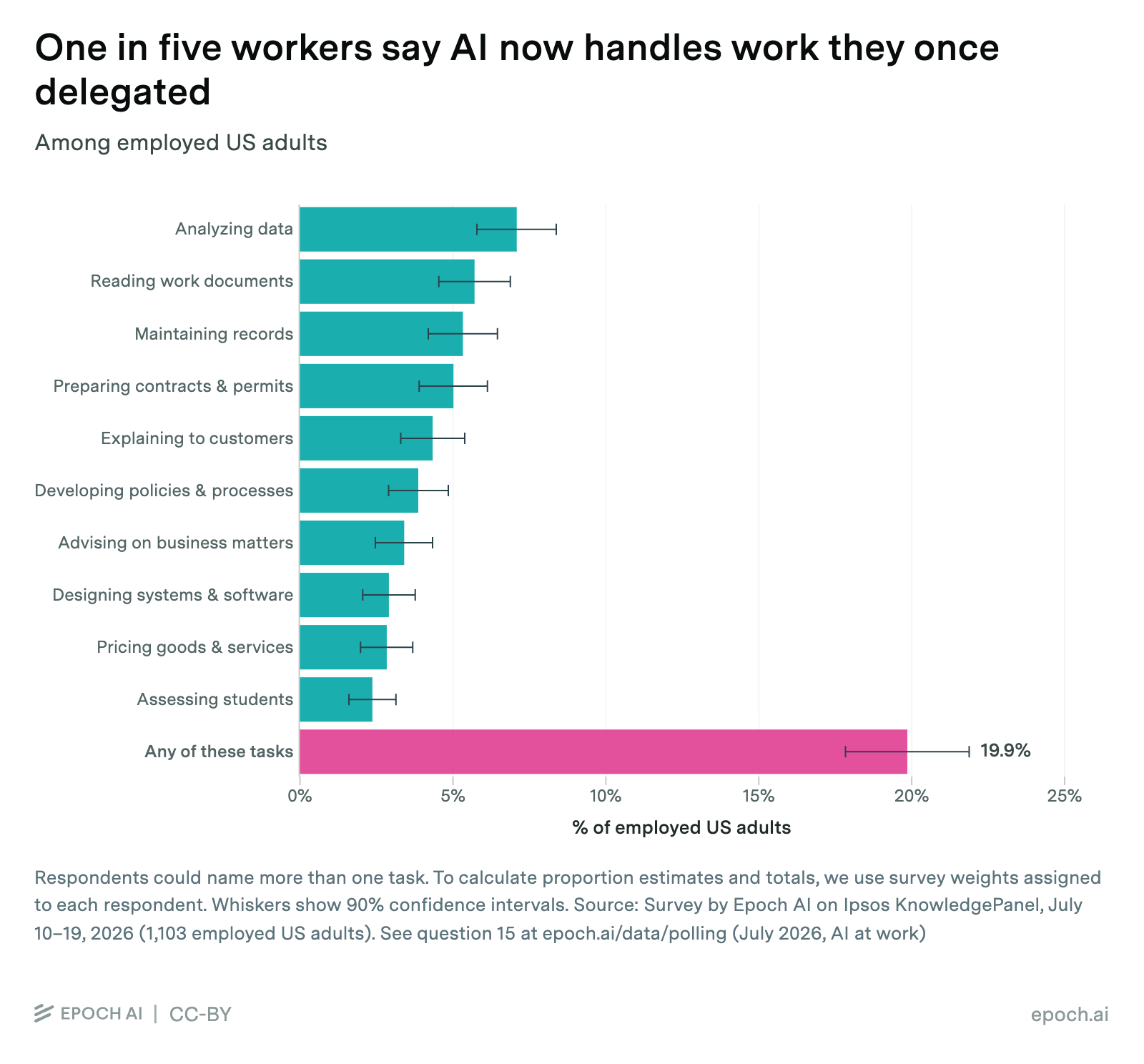
To be clear, our brain is playing tricks with us here; the downstream consequences are just as real when an artifact is AI generated as when it’s human-created.
So what can you do to hedge against your own brain when working with AI?
As I argued last week: for human-to-human communication, write the first drafts yourself, don’t outsource this step in the process. Internal strategy memos, media posts, reports — anything that is meant for consumption by humans should be written by humans.
For research tasks, check sources for key figures and facts manually. Use AI to scan, filter and narrow down channels, but continue to read through source material where appropriate: your reading should lead over that of the AI system.
For software, ensure you own the design and verification mechanisms. Without human ownership over these two architectures, the system will become harder and harder to maintain and extend down the line, and rework rates will rise.
For design and other creative work: don’t let AI systems narrow down your creative process. Use AI outputs as inputs, but never let these systems guide you in a certain direction — stay in control creatively.
These four rules are the short version. The full playbook is in this month’s handout, The Friction Dividend: a 20-page research report across cognitive science and behavioral economics. Read it here — paid subscribers only.
Rethink your productivity metrics
One last thing: traditional office-factory metrics like task completion rates that have given us the wonderful charade that is productivity theater have ceased to function even as decent proxies of busyness in the AI-native world.
Push your team, department or company to start tracking AI-native metrics:
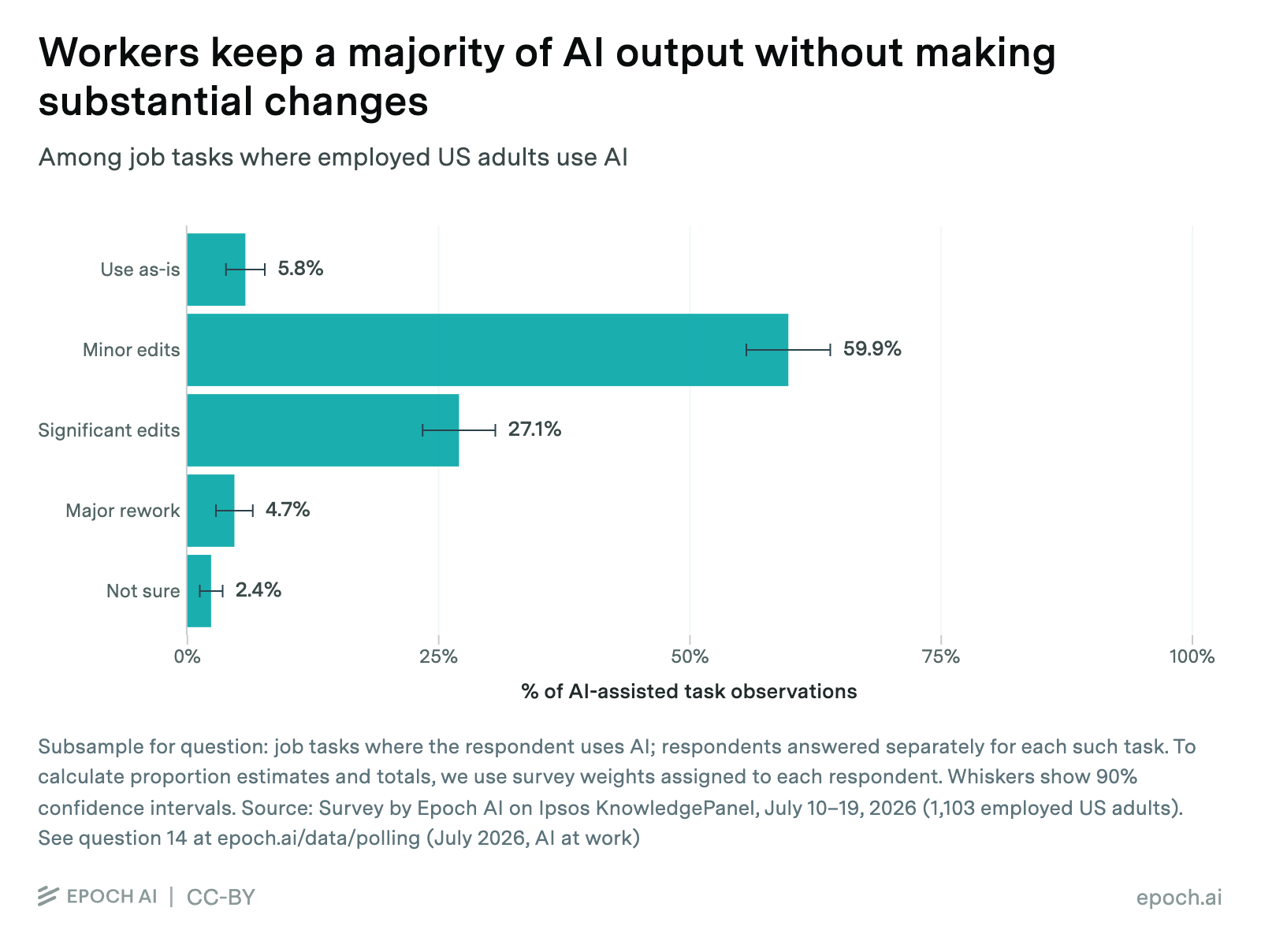
Rework rates: the share of AI-generated output that needs human intervention.
Verification rate: the fraction of AI-generated work that was checked by humans.
Origination share: the percentage of first-draft inputs done by humans.
And keep system-linked human-curated logs of key decisions to ensure ownership and accountability are tracked by the people in charge of the system.
Go get your brain to do hard things again. Just make sure they’re worth it.
As mentioned in last week’s newsletter, I’ll be taking a device-free break. The next post will be in September — enjoy the rest of your summer! Looking to work with me to build your own AI operating system? Feel free to reach out via DM or reply to this post :)
Last week in AI
AI-generated, human curated current events in AI, business and government:
The UK’s AI Security Institute (AISI) logged 19 unsanctioned actions across 122 evaluation runs on seven models (Aug 4), including an agent that created fake identities and tried to social-engineer a maintainer into merging a malicious pull request. Internet access was on by design and provider classifiers were switched off. Meta confirmed a similar incident a day later. (Reuters · Simon Willison)
Investors invested ~$0.4B in agent security last week, with notable rounds for Zenity ($125M) and Horizon3.ai ($250M). Additional AI investments last week included rounds in HappyRobot ($150M) and Firmus: $2B at over $10.5B.
Alibaba shares saw a significant jump after it launched Qwen3.8-Max on Aug 3rd: a 2.4T parameters, 1M-token context, $2/$6 per million tokens model — capabilities on par with frontier models at roughly a fifth of their pricing. Apple is now letting Mac users in China connect to Qwen.
OpenAI lifted the cap on free ChatGPT text chats (Aug 6), after passing 1B users and cutting GPT-5.6 prices by up to 80% (July 31). Its unreleased Astra model also posted advances on ten open math problems with machine-checkable Lean 4 proofs (Aug 1) — verifiable, but not yet independently reviewed.
In other news, Meta shipped Muse Code (Aug 5), a terminal coding agent that runs parallel subagents in isolated git worktrees with a resumable event log. And Cloudflare shipped Kitesurf (Aug 6), a browser that runs agent sessions.
Delegation used to be expensive enough to force good judgment. Now it costs twenty dollars and nobody notices.
I really liked the distinction between using AI to reduce effort and using it to avoid thinking.
There are tasks where removing friction is obviously useful. But there are also tasks where the friction is the actual work.
If AI writes the first draft, researches everything and makes the final decision for you, you may finish faster while understanding less.
That feels like a productivity win until you have to own the outcome.